
OGMP 2.0, reported from measurement you can defend.
Reach OGMP 2.0 Level 4/5 from reconciled measurement: SensorUp ingests every source, runs statistical reconciliation, and produces audit-ready reporting.

Every source ships its own format, and none of them agree
Drones, monitors, surveys, satellite, and inventory each say a different number.
Each measurement source arrives in its own format on its own cadence, and none is aware of the others. OGMP 2.0 asks for one reconciled figure anyway, so the disagreement lands on whoever assembles the report.
The number is built once a year, in a spreadsheet no auditor can walk
Manual joins and one analyst's judgment, rebuilt every reporting cycle.
Reconciliation happens in Excel: CSV exports, manual joins, and one analyst's judgment in formulas nobody else can audit. Every reporting cycle starts the assembly over, and the method leaves with the person who built it.
When the external auditor asks how the number was derived, the answer is a deck
UNEP submission needs evidence in the system, not a recollection.
The figure is only worth what its evidence chain survives. When an external verifier asks how it was derived, a slide is not an answer, and the gap between measured and reported is where the level slips.
Fits your stack
Every measurement source, read where it lives
Drones, monitors, LDAR, satellite, and inventory, all ingested together
Every source normalized into one model, not compared side by side.
Continuous monitors, OGI surveys, aerial and satellite passes, and bottom-up inventory land as Observations in one canonical model. The sources stop living in separate portals and become comparable records tied to the assets they describe.
consume: drones, CMS, LDAR, satellite, inventoryStatistical reconciliation, not a spreadsheet average
Monte Carlo extrapolation, uncertainty quantification, source-level attribution.
Reconciliation runs statistically: Monte Carlo extrapolation, uncertainty quantification, and source-level attribution built for L4/L5, so the reported number carries its confidence interval and holds up in front of an auditor.
reconcile: Monte Carlo + uncertainty → one numberThe OGMP 2.0 L4/L5 methodology lives in the Library
Levels, methods, and factors are Library content, not custom code.
The OGMP 2.0 levels, methodologies, and emission factors are Library content, applied the same way every cycle. The report is composed in Studio against that framework, on the same foundation that serves [Methane detection](/solutions/methane) and corporate GHG.
compose: Library framework → OGMP entryCatch → Prioritize → Resolve
From every source to an audit-ready submission
Every source lands in one model, tied to the asset it implicates
Readings land as Observations against facilities and equipment, normalized once.
Drone, monitor, survey, satellite, and inventory readings land as Observations tied to the assets they describe, normalized once. The disagreement between them becomes visible and reconcilable, with the provenance to settle it.
The reconciliation weights each source and surfaces where the number is weakest
Statistical attribution ranks which readings drive the figure and which gaps to settle first.
Monte Carlo extrapolation, uncertainty quantification, and source-level attribution weight the sources against the OGMP methodology, ranking which readings carry the number and flagging the discrepancies that matter most. Your team settles the material gaps before submission instead of chasing every reading equally.
Every reported figure traces to its measurement, retained for verification
The submission carries its evidence chain into external audit.
The reported figure moves into sign-off carrying its full lineage: every source, method, and adjustment retained in the system. An immutable audit trail records each change, so the UNEP submission arrives with evidence an external verifier can walk, not a reconstruction.
The building blocks
The OGMP report is composed from the same blocks
The OGMP 2.0 submission is assembled in Studio from shared blocks, run by Autopilot on the Warehouse record beneath it. The same reconciliation runs Methane detection and every solution in the catalog.
- Events
- Work
- Calculations
- Compliance
- Scenarios
- Metrics
- Reports
- Agents
- Cora
- Solution Builder
- Workflows
- Assets
- Integrations
- Datasets
- Relationships
- Reference Library
- Ledgers
- Approvals
See it in action
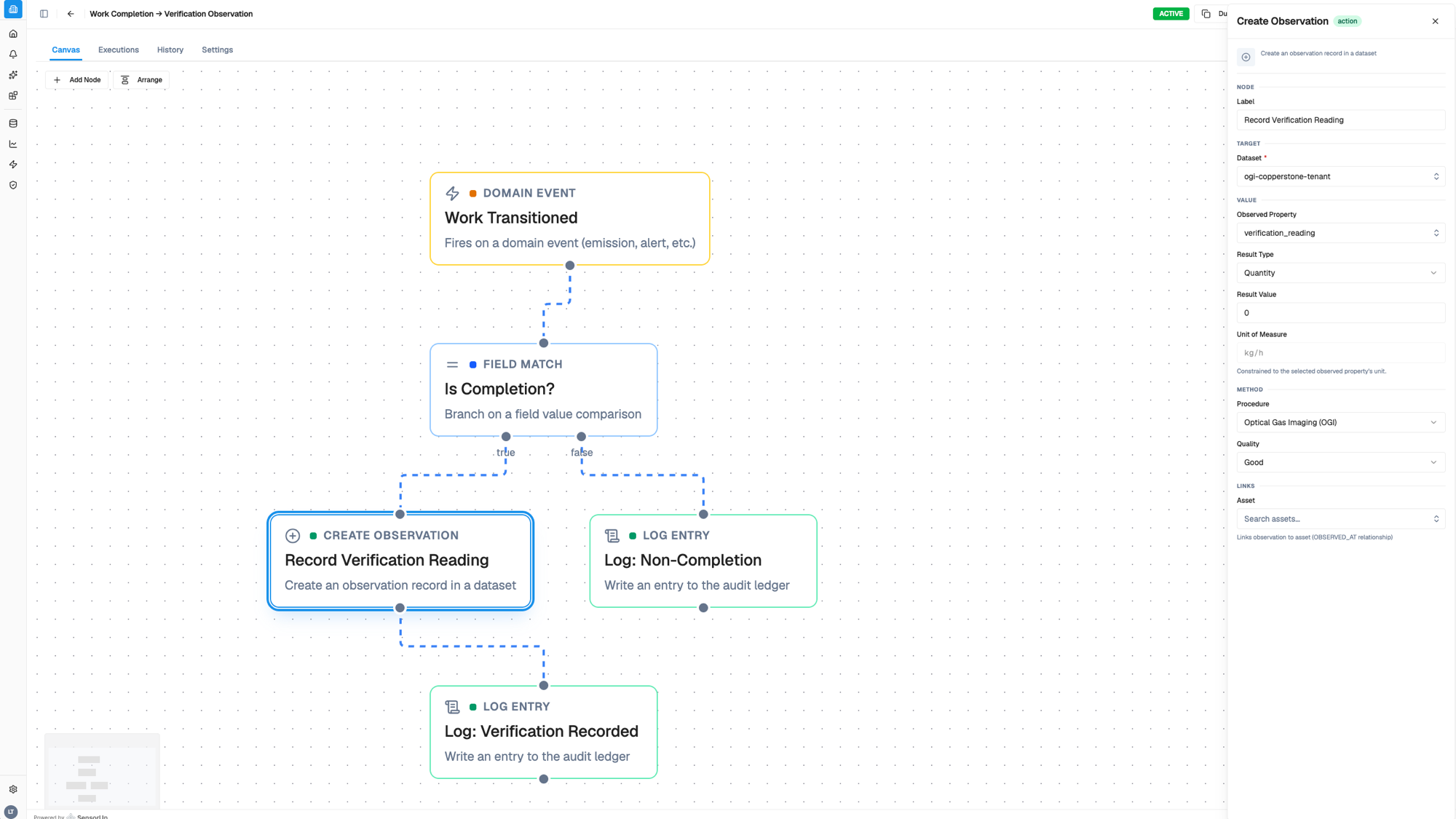
See the evidence chain record itself as work completes
When a work order transitions to complete, an active workflow records its verification reading to a dataset, links the observation to the asset it was taken on, and writes the result to the audit ledger — non-completions are logged too, so the branch that did not happen is on the record as well. The provenance an OGMP 2.0 submission rests on is captured as the work happens, not reconstructed at reporting time.
Talk to an engineer
Bring your OGMP 2.0 submission and the sources behind it. We'll reconcile them against your actual stack and show the evidence chain an external auditor will accept.