
LDAR doesn't fail at detection. It fails at proof.
LDAR programs fail in the gap between a detection and a documented repair. SensorUp turns OGI, continuous monitor, and satellite findings into owned work.
Detections die in inboxes
A finding becomes an email, then a row, owned by no one.
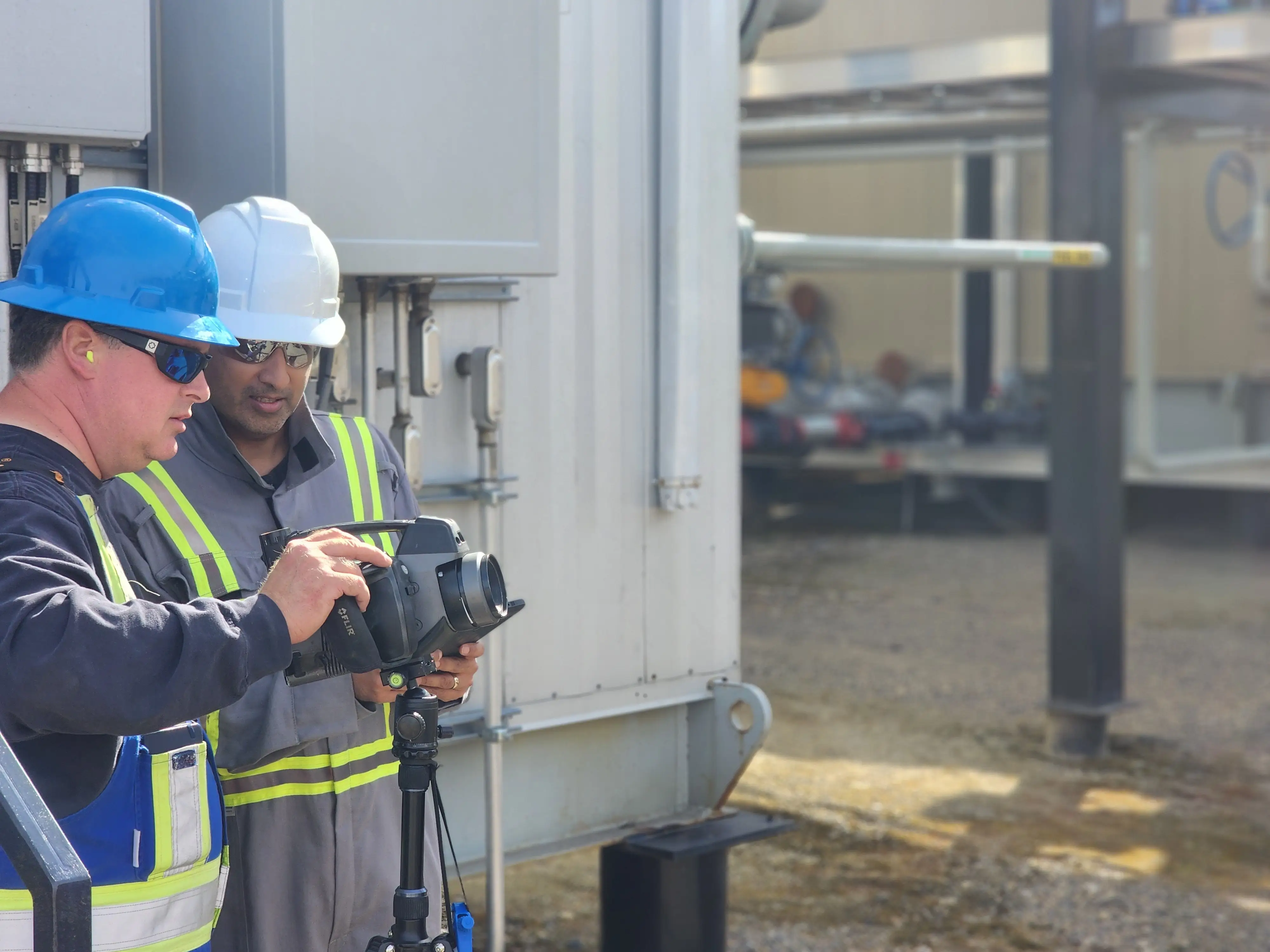
A camera operator's finding becomes an email, the email becomes a spreadsheet row, and ownership never lands on anyone. The leak may even get fixed, but months later, nobody can show who was assigned, when they acted, or against which finding.
Your detection sources disagree
Three findings, possibly one leak, chased as if new.
The OGI survey says one thing, the continuous monitor says another, and a satellite flags the same pad days later. Three findings, possibly one leak, and without a reconciled record, your team chases each signal as if it were new.
Closure you can't defend
An undocumented repair reads as a violation either way.
The repair happened; the documentation is a text message and a technician's memory. Under regulatory scrutiny, an undocumented repair is indistinguishable from an unrepaired leak, the gap reads as a violation either way.
Fits your stack
It reads the detection sources you already run
OGI, continuous, and satellite land as records, not attachments
Every survey, alarm, and pass becomes an observation linked to its asset.
OGI cameras (FLIR, Opgal), continuous monitors (Project Canary, Qube, LongPath), and satellite (GHGSat, MethaneSAT, Planet) all ingest as observations linked to the asset they observed. A continuous alarm, a quarterly survey, and a satellite pass become comparable records, not parallel portals and PDFs nobody can action.
consume: OGI, monitors, satellite → ObservationsOperational state separates the leak from the vent
A detection is cross-referenced against state before a work order.
The Warehouse reads your SCADA historians (PI, CygNet) over OPC-UA and Modbus, so a detection is cross-referenced against pressure, flow, and valve state before it becomes a work order. A scheduled vent should never dispatch a truck. Ingress is pull-shaped, so nothing new lands on the OT segment.
consume: PI, CygNet ← OPC-UA / ModbusThe LDAR frameworks live in the Library
OOOOa/b/c and the Appendix K protocol, with emission factors, as Library content.
The methodologies your program answers to, OOOOa/b/c and the Appendix K imaging protocol, and the emission factors behind them, are Reference Library content: versioned, inspectable, and applied the same way every survey cycle.
Catch → Prioritize → Resolve
A finding becomes owned work with documented closure
Find the real leak in the noise
Every source lands in one record, so the real leak stands out from the duplicates.
Every reading, OGI, continuous, satellite, SCADA, lands as an observation linked to the asset it observed. When sources disagree about the same pad, the disagreement is visible in one record with provenance, not scattered across inboxes.
See what actually affects your operations
A confirmed finding becomes a tracked event, ranked against your operating plan.
A confirmed finding opens an emission event, related to its asset and carrying its detection history, ranked against your operating plan so the leaks that actually affect operations rise first. It is tracked from open through verification to closure, the thing the auditor follows, and it cannot quietly disappear into a thread.
Send it to the right team, and close it out
Dispatched as owned work with escalation, closed with documentation an auditor accepts.
LDAR survey sequences, repair orders, inspection checklists, and escalation paths, composed as workflows and dispatched as owned tasks: an AVO check, an OGI re-survey, or a vent, flare, or blowdown report. The workflows map to OOOOa/b/c and the Appendix K imaging protocol. If a repair stalls, the escalation path fires; if it completes, the closure documentation is attached where the event lives.
The building blocks
Every LDAR is composed from the same blocks
LDAR is not written from scratch. It is assembled in Studio from blocks that already exist, watched by Autopilot and standing on the Warehouse beneath it. Change the composition, and you change the solution. The same blocks compose the EPA Subpart W filing your LDAR records feed, and every other entry in the catalog.
- Events
- Work
- Calculations
- Compliance
- Scenarios
- Metrics
- Reports
- Agents
- Cora
- Solution Builder
- Workflows
- Assets
- Integrations
- Datasets
- Relationships
- Reference Library
- Ledgers
- Approvals
See it in action
See every detection open into the record behind it
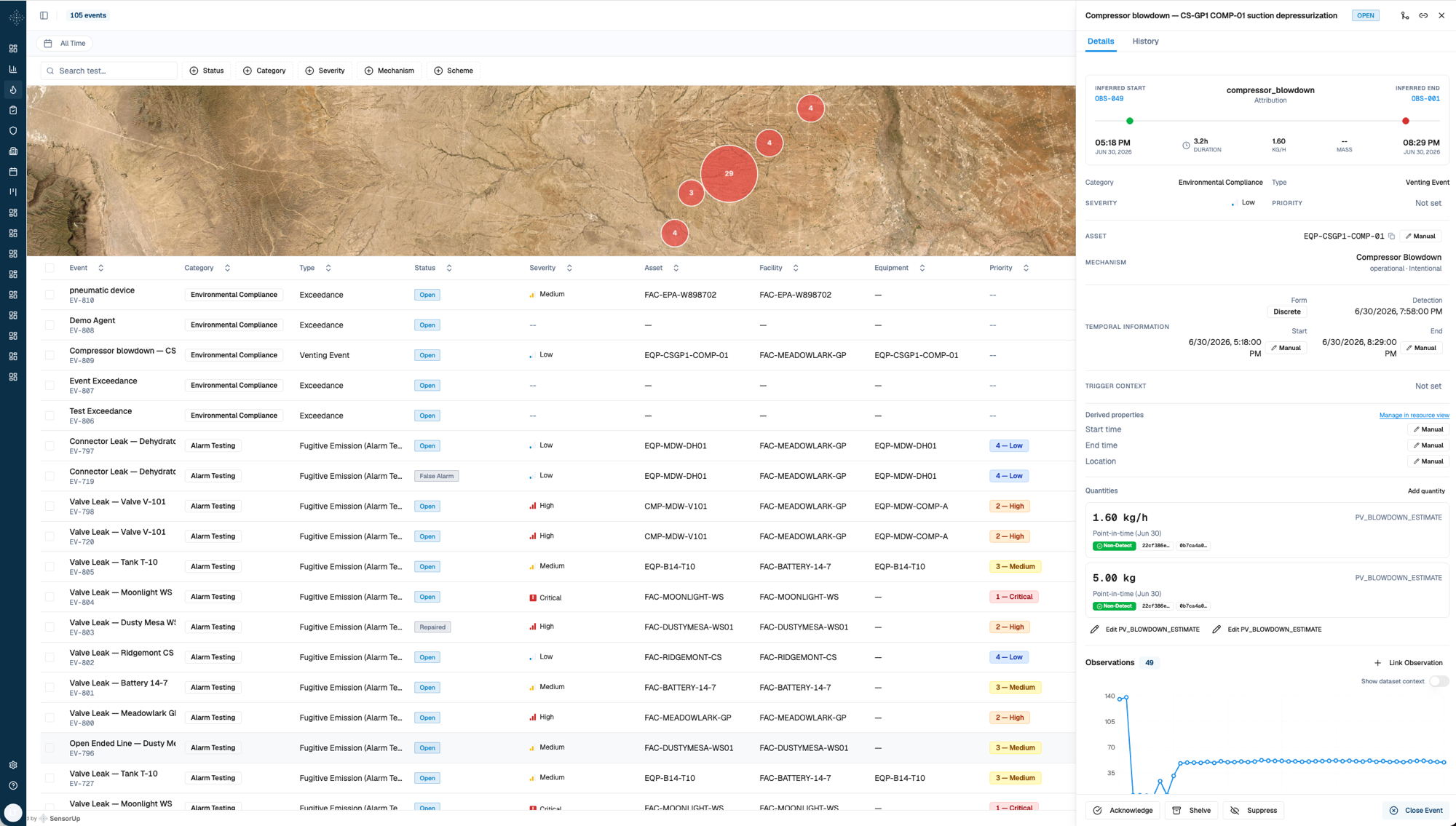
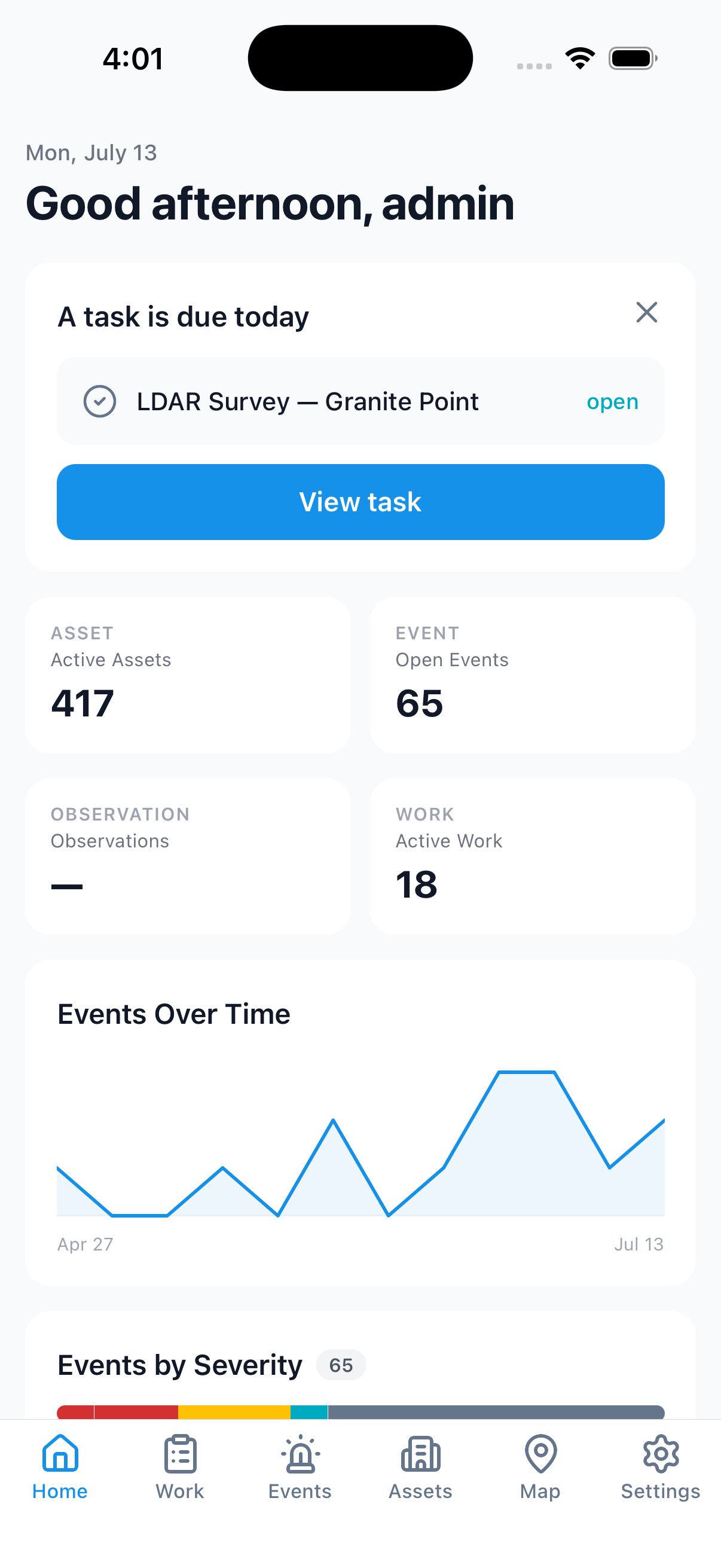
The events queue collects every detection — fugitive leaks at valves and connectors, exceedances, venting events — over a map of the sites they came from. Open one and it expands to its full record: mechanism, quantified rate and mass, inferred start and end, and the observations that attributed it. That is the documented chain that turns a raw detection into a finding an auditor can follow.
Talk to an engineer
Bring your survey schedule and your detection stack. We'll walk sources, work dispatch, and the audit trail against what you actually run.