
EPA Subpart W, filed from data you can defend.
File to the EPA from data you can defend: SensorUp composes your Observations, Calculations, and an immutable audit trail into the Subpart W submission.
Your sources don't tell one story
Each system is right; none agrees on what the facility emitted.
The historian says one thing about run hours, the OGI survey logged a leak the CEMS export never saw, and the satellite alert arrived as a PDF. Each system is right about what it measured, none of them agrees on what the facility emitted. The filing requires that they be made to agree, with the disagreement on record.
The spreadsheet is the system of record, and it shouldn't be
Each season an engineer rebuilds the reconciliation by hand.
Every reporting season, an engineer rebuilds the reconciliation: exports pulled, units converted, emission factors looked up, formulas patched from last year's version. The institutional knowledge lives in cell comments and an inbox. When that engineer changes jobs, the methodology goes with them.
An audit question lands years after the filing
The answer must run from filed number back to source measurement.
When the regulator asks where a value came from, the answer has to run from the filed number back to the source measurement. If the trail runs through versioned spreadsheets and email threads, your team reconstructs it under scrutiny, and every gap in the reconstruction reads as a gap in the filing.
Fits your stack
It reads the records your operations already write
It reads the systems you already run, and doesn't replace them
Historians, CEMS, cameras, monitors, and satellite, read where they live.
The Warehouse reads the systems you already run: SCADA historians (PI, CygNet) over OPC-UA and Modbus, CEMS, OGI cameras, continuous monitors, satellite, and SAP or Maximo for asset context. It only reads them, so nothing new lands on your control network.
consume: PI, CygNet ← OPC-UA / ModbusThe malformed export is the expected input
Raw records stay addressable even after normalization.
Raw records are kept as ingested, then projected into one canonical model, so the original export stays addressable. Transform does the work the spreadsheet used to: normalization, unit conversions, factor lookups, and data-quality scoring, as a pipeline you can inspect.
raw record → canonical observationThe Subpart W methodology lives in the Library
Rule sets, calculation methods, and emission factors are Library content, not macros.
The Subpart W calculation methodologies and emission factors are Reference Library content: versioned, inspectable, and applied the same way every cycle, instead of a spreadsheet macro that changes whenever someone edits a cell.
Catch → Prioritize → Resolve
The filing is caught, ranked, and resolved to one defensible number
Every disagreeing source lands in one model
Historian, CEMS, OGI, and satellite become comparable records, disagreement kept.
The historian, the CEMS export, the OGI survey, and the satellite pass each measure a different slice of the facility. They land in one canonical model on arrival, comparable records with their disagreement kept on the record, not averaged away before anyone can see it. The records your LDAR program already writes feed directly into this filing.
Numbers derived continuously, not rebuilt at the deadline
Correct a source value and the derived value moves with it.
The engine derives emission values from observations as they land, with factors pulled from the Library, not hand-keyed. Correct a source value upstream and the derived value moves with it, with the change recorded.
A discrepancy becomes owned work with documented closure
Discrepancies dispatched as owned work, closed with documentation.
When reconciliation surfaces a discrepancy, it is dispatched as owned work, the same machinery that runs LDAR repairs, and closes with documentation attached to the record, not an email thread.
The building blocks
The filing is composed from the same blocks
The Subpart W filing is assembled in Studio from shared blocks, run by Autopilot on the Warehouse record beneath it. The records your LDAR program writes feed this filing, and the provincial BCER / SWRS submission runs the same way. See every solution.
- Events
- Work
- Calculations
- Compliance
- Scenarios
- Metrics
- Reports
- Agents
- Cora
- Solution Builder
- Workflows
- Assets
- Integrations
- Datasets
- Relationships
- Reference Library
- Ledgers
- Approvals
See it in action
Watch a Subpart W submission assemble from the stack you already run
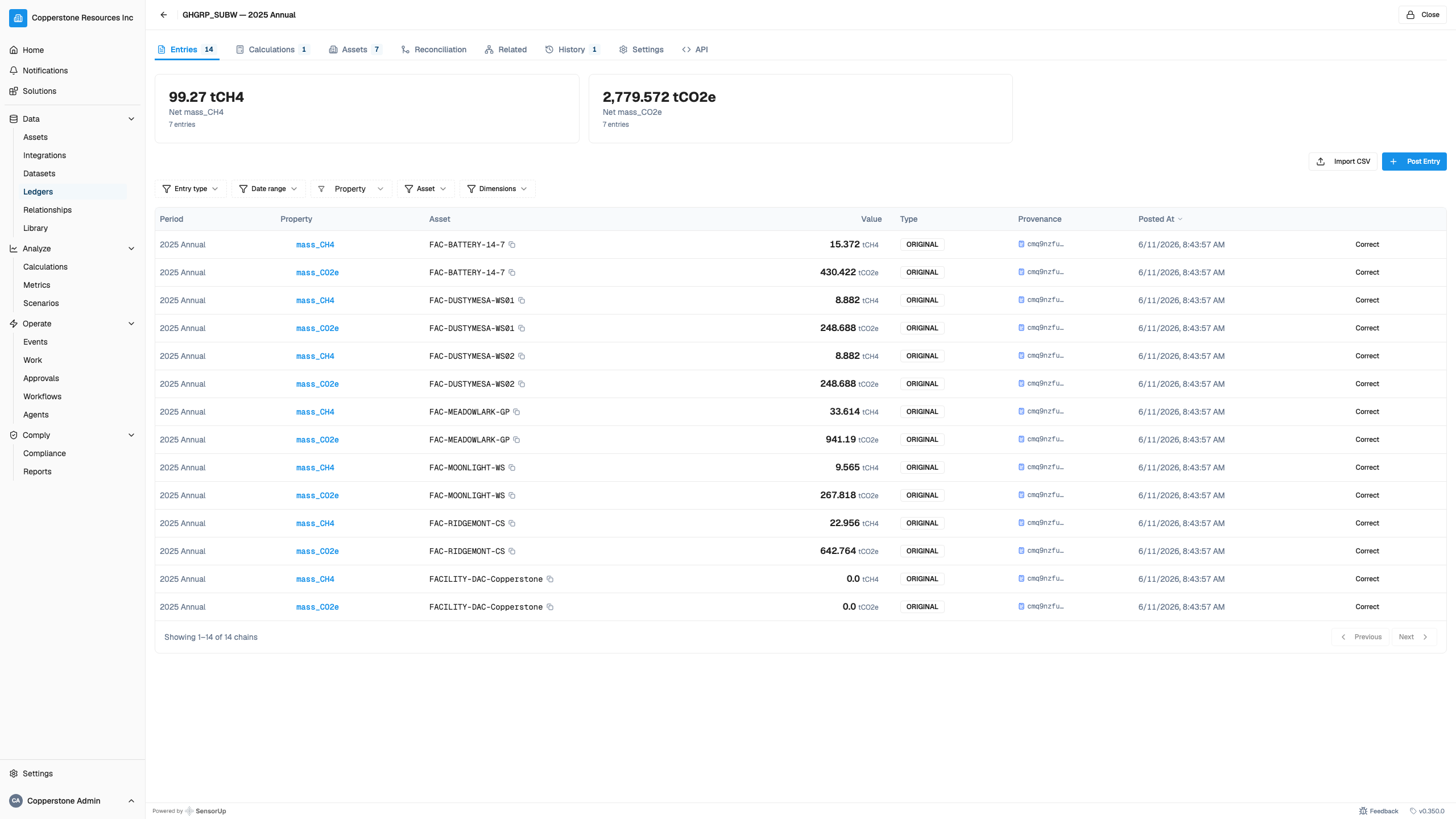
Facility data flows through a pipeline into the calculation and out as a report, every figure tied to the asset and reading it came from.
Talk to an engineer
Bring last year's filing and the spreadsheet behind it. We'll scope which calculation paths apply to your equipment, walk the audit trail end to end, and tell you where the reconciliation will hurt.