
Corporate GHG: one number you can defend.
The corporate GHG inventory, composed continuously from reconciled operational data, an audit trail from sensor to submitted value for OGMP 2.0 and investors.

The assembly is the exposure, not just the cost
Hand-built workbooks turn auditor questions into archaeology.
Every reporting cycle, someone pulls historian exports, survey results, and vendor CSVs into a workbook and reconciles them by hand. The methodology lives in that person's head, so when an auditor asks how a value was derived, the answer is archaeology.
The inventory diverges from the operation it describes
Reported and operational numbers drift, then clash under deadline.
The number you report and the number your operations run on are assembled by different people from different extracts, and they drift. When they disagree in front of a regulator or investor, the reconciliation happens under deadline, the worst place to do it.
Each framework gets its own assembly, so the answers multiply
Built by hand, every framework becomes a separate assembly.
OGMP 2.0 wants measurement-reconciled methane. Investors want Scope 1, 2, and 3. EPA Subpart W wants facility-level calculations on its own methodology. Built by hand, each becomes a separate assembly, the same wells, answered differently per audience.
Fits your stack
It reads the systems your inventory already comes from
Your historians and ERP are inputs, not export chores
The Warehouse reads your source systems where they live.
The Warehouse reads the systems your inventory already comes from: SCADA historians (PI, CygNet) over OPC-UA and Modbus, SAP and Maximo, continuous monitors, satellite, and OGI. It reads them where they live, instead of waiting for the annual export.
consume: PI, CygNet ← OPC-UA / ModbusEvery source lands in one model, and keeps its lineage
CEMS, OGI, and satellite normalize into one model; every value keeps a lineage you can walk.
A CEMS value, an OGI reading, and a satellite detection normalize into one model on arrival, comparable records in one store of truth. Every value stays linked to its observations, and an immutable audit trail records every change, so a reviewer walks the lineage instead of hunting a tab.
normalize + trace: sources → observations → source tagEvery framework's methodology lives in the Library
OGMP 2.0, MiQ, and Veritas methodologies are Library content, applied the same way every cycle.
The methodologies your inventory answers to, OGMP 2.0, MiQ, Veritas, and the emission factors behind them, are Reference Library content: versioned, inspectable, and applied the same way every reporting cycle. The same measured data produces each framework's number without a separate rebuild.
frameworks: OGMP 2.0, MiQ, Veritas ← LibraryCatch → Prioritize → Resolve
The inventory becomes a calculation record, not a workbook
Every facility's data lands in one record
Every facility arrives in one structure; conversions and factor lookups run as data lands.
OGI survey definitions, CEMS configurations, and SCADA tag registries become governed templates, so every facility's data arrives in the same structure. Transform pipelines then run unit conversions, Library factor lookups, and data-quality scoring as data arrives, with the factor applied to each value recorded alongside it.
The sources that move the number rise to the top
Derived intensities rank by contribution and flag against the targets you set.
The calculation engine derives emission rates and methane intensity from observations, then the inventory ranks them: which sources dominate, which facilities run over the targets you set in Metrics. What needs attention rises to the top instead of hiding inside a total.
One inventory that holds, traceable to source
Every facility rolls into one number, each value traceable to the reading beneath it.
The facilities roll up into one corporate inventory on a single record, every derived value linked back to the observations it came from. When an auditor or investor asks how a number was built, the answer is the record itself, walked from submitted value to source reading, not a workbook reassembled after the question.
The building blocks
The inventory is composed from the same blocks
The corporate inventory is assembled in Studio from shared blocks, run by Autopilot on the Warehouse record beneath it. The same blocks roll up the facility-level EPA Subpart W filing, report out through OGMP 2.0, and compose every solution in the catalog.
- Events
- Work
- Calculations
- Compliance
- Scenarios
- Metrics
- Reports
- Agents
- Cora
- Solution Builder
- Workflows
- Assets
- Integrations
- Datasets
- Relationships
- Reference Library
- Ledgers
- Approvals
See it in action
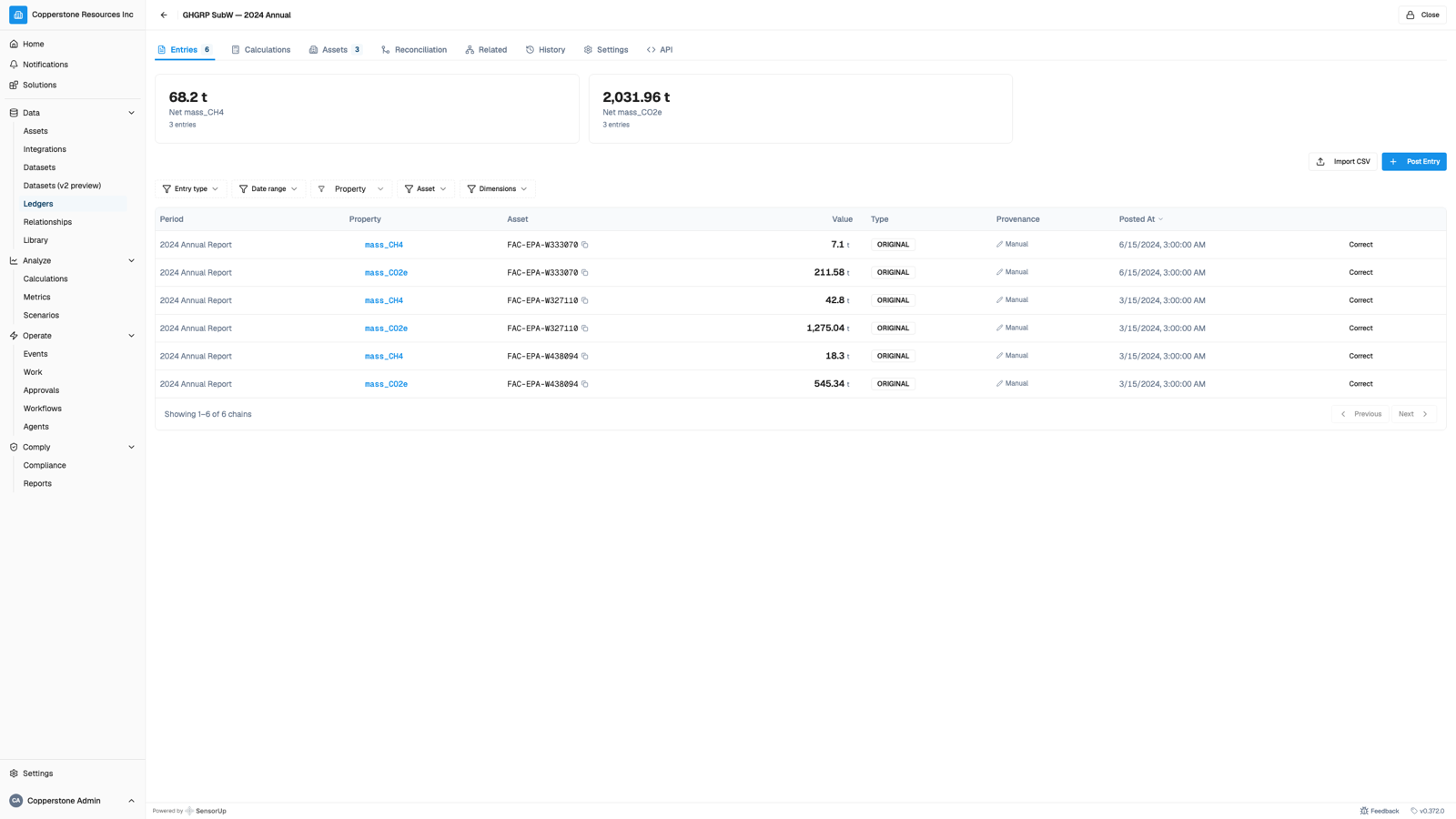
Follow an inventory number from raw activity data to a defensible ledger
Emission factors and activity data resolve into a calculation graph you can open, not a spreadsheet's hidden formulas, and every derived value keeps its lineage.
Talk to an engineer
Bring the workbook you assemble every year. We'll walk consume, normalize, and derive against your actual stack, and show you where the audit trail picks up.